
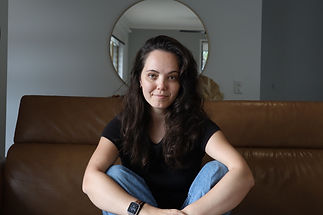
Hello, I'm Kristyn
The world knows me as Dr. Kristyn Sommer, the autistic scientist who explores how children learn and navigate the world with humans and technology (and occasionally robots too). I'm "that scientist" you might have seen on your TikTok for you page, Instagram feed or Facebook page. Last year, I popped up on over 10 million screens worldwide sharing everything I have learnt about children through my decade teaching developmental psychology at the University of Queensland, researching alongside some of the worlds greatest learning scientists with the Jacob's Foundation and, most importantly, raising my own two children who are (as of 2026) six and two years old.


Education
2011-2014
Bachelor of Psychological Science (Honours)
The University of Queensland, Australia
2015-2020
PhD, Developmental Psychology
The University of Queensland, Australia
Teaching & Research
2015-2021
Developmental Psychology Course Coordinator, Lecturer, Lead Tutor
The University of Queensland, Australia
2022-2025
Griffith University Postdoctoral Research Fellow Awardee
Griffith University, Australia
2022-2025
Jacob's Foundation Research Fellow (Switzerland)
In residence at Griffith University, Australia
I've spent 12 years in some of the world's best learning science labs. I built Many Minds because none of that knowledge was reaching the people who needed it most.
I understand children from the inside out. Scientifically, personally, and in real time.
Taught by millions
Years of sharing child development science online have given me something no research degree could: direct, unfiltered feedback from parents and teachers all over the world.
What I've learned? How to phrase things, how to approach a topic carefully, and the difference between what people want to hear and what they actually need to know.
That education has shaped everything about how I work.
Autistic
When you don't understand the rules of the game, you enter the world with no assumptions and an innate ability to construct, or deconstruct, what is a soical norm versus what is good for humans.
I questions what others move past. I see the children who look fine but aren't. Because they're hiding in plain sight.
Questioning even the most basic assumption is the foundation of everything I teach.
In it
The research I teach is the same research I rely on every single day.
Why? Because I am in the thick of raising little kids. I'm navigating school and trusting my small humans with peers and educators that I can only hope are able to give them what they need.
What I teach isn't without an anchor. The anchor is real life. My life. There is no gap between what I know and how I live.
My Story
For as long as I can remember, there was a game everyone else seemed to be playing.
I didn't know the rules.
I wasn't even sure I knew the name of the game.
But I was abundantly, uncomfortably aware that everyone around me appeared to know both in a way I simply did not.
So, as a young child, I watched. And the first people I watched were my peers. Children. I studied them the way you study something you want desperately to understand. From the outside. Carefully. I wanted to understand the rules so I could join in.
It is not lost on me that I went on to dedicate my entire life to that very endeavour.
I studied psychology at university and stayed for a PhD. Years running experiments with kids of all ages to answer one question: can children learn from a robot the way they learn from a person?
The answer has almost nothing to do with the robot.
It has everything to do with whether the child feels safe, whether they feel connected, and whether what you are asking of them makes sense for where they are developmentally that day.
There was an even more unusual element to my PhD. I was the only developmental scientist on a team of engineers. I had to quickly become an expert translator across two very different worlds if I were to survive and appease my supervisors who were all world class scientists in their respective fields (yes, that was occasionally terrifying).
Engineers are brilliant at building things and very good at asking whether something works. What they are less practiced at, and I say this with genuine affection for the people I spent years alongside, is asking whether something is right for a particular child, at a particular age, on a particular day. Those were my questions. I asked them constantly. I was usually the person in the room who slowed things down and asked "but why?"
Slowing things down to ask the right question is one of the most undervalued skills in any field. But in a room full of people optimising for function, it can feel a lot like being a problem.
I finished my PhD in 2020 with a new baby and a pandemic arriving simultaneously. COVID hit when she was a newborn. Postpartum depression and anxiety hit too.
At nine months postpartum, I walked into my first ever psychiatric appointment. The psychiatrist, within minutes of meeting me, asked if anyone had ever suggested I might be autistic.
Nobody had.
Not once.
Not in 27 years.
The answer, it turned out, was yes. The game I had spent my whole life trying to reverse-engineer had a name. A lot of things made sense at once.
As I clawed my way out of postnatal depression and anxiety, I posted a video about child development on TikTok.
It went viral
so I posted another
then another
Within a year, nearly half a million people were watching regularly. Parents. Teachers. Carers. All asking the same questions, differently phrased. All hungry for something that should have reached them long before they ended up watching a thirty-second video at midnight.
I spent the years that followed working as a researcher, eventually with the support of a prestigious international children's research foundation. I taught. I supervised. I sat in rooms with some of the best researchers in children's learning in the world, building a detailed picture of how children's minds actually work.
And because of my social media platform, I had started talking to teachers and parents everywhere. I heard what they were actually working with. Approaches the research had moved on from, still being handed out as best practice. Dedicated, caring people doing everything they had been taught to do, with information that was simply out of date.
Not because they weren't paying attention. Because nobody had told them things had changed.
There is a gap, on average seventeen years, between what research discovers and what reaches everyday practice.
Seventeen years.
An entire childhood.
In 2025, my oldest child started school. On their first day, I met an occupational therapist whose child started school the same morning.
We started comparing notes on what the research said and what was actually reaching families. The gaps were everywhere. The knowledge existed. A way to share it, simply and without judgement, largely did not.
And so Many Minds was born.
Built from all of it. The childhood spent watching from the outside, trying to understand. The PhD spent as the only person in the room asking the human questions. The years watching knowledge stay locked inside institutions most people will never enter. The messages from teachers who had never heard of window of tolerance until three weeks ago and now cannot unsee it in their classrooms. Colliding with any expert is yet another distinct field of science asking the same questions I was but through a different lens.
Many Minds is not a response to what is broken.
Many Minds is an investment in what is possible when the knowledge that already exists finally reaches the people who need it most.
You.
Contact
If you are looking to connect with Dr. Kristyn Sommer in regards to her social media or public persona, please direct enquiries to drkristynsommer@gmail.com